Thursday, April 21, 2005

M51 Image Processing (refer to Grayscale Image Processing Tutorial)


©2006 Richard Murray

M51 The Whirlpool Galaxy Below are some of the steps involved in processing the final images.


©2006 Richard Murray

Friday, April 08, 2005

M64 The Blackeye Galaxy


©2006 Richard Murray


Techno Stuff: 4/8/05, LX90 8" SCT, ATK-2HS, Taurus Mini Tracker, Baader IR, Guided, Darks Used, 5fps, 6 x 240 secs, 15 x 480 secs, 6 x 720 secs, Brightness 50%, Gamma 15%,Sat 50% Gain various from 30%-55%, White Balance nothing selected, Processed in K3ccdTools, Registax 3, Photoshop, Loreal, NeatImage.

Thursday, April 07, 2005

M51 - Two Galaxies in Collision! News at 11:00 . . . .


©2006 Richard Murray

Techno Stuff: 3/4/05, LX90 8" SCT, ATK-2HS, 0.6 FR, Baader IR, 5fps, 28 x 50.5 secs, Brightness 50%, Gamma 50%,Sat 50% Gain 85%, White Balance nothing selected, Darks used, Unguided, Processed in K3ccdTools, Registax 3, Photoshop, Loreal, Pleiades SGBNR.

Friday, April 01, 2005

M57 The Ring Nebula


©2006 Richard Murray

Techno Stuff: 4/1/05, LX90 8" SCT, ATK-2HS, Taurus Mini Tracker, Guided, Ha Filter, No Darks, 5fps, 1 x 240 secs, Brightness 50%, Gamma 80%,Sat 50% Gain 75%, White Balance nothing selected, Processed in K3ccdTools, Registax 3, Photoshop, Loreal

7/24/04 LX90 8" SCT, Vesta 690k SC1.5, RAW mode, No Filter, Equatorial Mount Unguided 40.5 sec x 38, Dark Subtract, Brightness & Gamma 50%, Gain 85%

Thursday, March 31, 2005

Scopebuggy Heaven

I just got my Scopebuggy last week! No more
whining about lifting my heavy scope or
having to set everything up each time
I go out. Now I just roll everything out
connect my cables and go.

And notice the fancy chrome plated wheels.
Those babies are 10" numatic tires. Very
gentle on the equipment.

So I should have some more images up of DSO's
soon. That is if I haven't forgotten how to
do all this stuff after taking 4 months off.

Rick


Sunday, March 27, 2005

The Shapes Of Planetary Nebula


©2006 Richard Murray

The picture above is a collage of images I have taken over
the past year with my LX90 telescope and modified webcams.


Sir Fred Hoyle, was an eminent astronomer and author of numerous books on science and cosmology, who decided to take a detour in 1957 and write a science fiction novel he referred to as his "frolic" called, 'The Black Cloud'. I still have the 1959 paperback edition of that book. The story unfolds as a young grad student by the name of Knut Jensen is searching for supernova using a blink comparator. He suddenly discovered in a rich star field a large, almost exactly circular, dark patch. Further scientific analysis revealed that this cloud was moving directly toward the sun, and that it appeared to be controled by some form of intelligence! Scientists puzzled over how an intelligent entity could control an enormous gaseous nebula, and decided that it must be done through the manipulation of magnetic fields within the cloud of gas:

"I imagine that the beast orders the material of the cloud magnetically, that by means of magnetic fields he can move materials wherever he wants inside the cloud."

Here's an image of the paperback edition below.


If you're wondering why this journal entry about planetary nebulae begins with a reference to a science fiction novel read on . . . . . . .

Planetary Nebula - fascinating objects to view and photograph, they come in all shapes and sizes: shells, rings, butterflies, bowties and hoursglasses. How they come about is no mystery. The real question puzzling scientists is why they take on such radically different shapes. But first let's take a brief look at the question of how they come about. Here is a quote from my earlier Journal entry on M76, The Little Dumbell [ M76 The Little Dumbell ]:

"For the most part, the type of nebulae that I have been imaging are planetary nebula. The first ingredient necessary to form one of these unique objects is a sun about the size of our own but no more than eight solar masses. After several billions of years, when most of the hydrogen has been burned, the core will contract, the temperature will rise and the star will become much larger and redder. Once the helium in the core ignites and becomes exhausted, the star begins to shed its gaseous envelope and enters a super red giant phase with most of the stars inner planets burnt and stripped of their atmospheres (nice thought huh?). Over thousands of years, the stars gas is shed even further through a process of stellar winds and 'helium shell flashes' (don't ask) to eventually form a planetary nebula. What shape this will take is anybody's guess which is part of the fascination in viewing and imaging these interesting objects. After 50,000 years or so the nebula will begin to dissipate into space leaving behind the stars old core which will transform into a white dwarf."

At least 95% of the stars we see in our own galaxy, the Milky Way, will share this same fate while the other 5% will literally blow up with a massive universe wide flash to become supernova. The total amount of matter returned to the interstellar medium by all the planetary nebulae in the galaxy is about 5 solar masses per year, which amounts to perhaps 15 percent of all the matter expelled by all sorts of stars. Planetary nebulae therefore play a significant role in the evolution of the whole galaxy.

Now on to why each planetary nebula shape is so distinctive. First of all, age and size: these nebula are mere infants on a cosmological time scale. Once the gaseous envelope is present their average age is about 10,000 years and they are typically 0.5 parsecs in diameter. A parsec is defined as the distance light travels in 3.26 years or 206,000 times the distance between our Sun and Earth. So the age of the nebula when it finally becomes visible to us determines, in part, its shape. A second factor is the nebulas orientation to our point of view. At one point it was therorized that all planetary nebulae have the same basic spheroid shape to begin with, its just the direction they face toward us that determines how we perceive there shape to be. This is partly true but by no means tells the whole story.

Around 1995 it was determined by Susan Trammell from University of Texas McDonald Observatory ,through an indirect observational method called optical spectropolarimetry, that whether a planetary nebula was to take on a spherical or asymmetric (non spherical) shape was determined at a very early stage of the nebula's development; so early, in fact, that they are not even optically visible to us. But that still doesn't explain what factors determine the shape. For example, what type of physical force could cause this NASA Hubble image of the mZ3 or Ant Nebula to be this dizzyingly complex!


Just look at all the loops, vortexes, filaments and bubbles that make up this thing. It really makes you just stand in awe and able to do nothing much beyond scratching your head.

But then some astrophysicists and magnetic field experts at the University of Rochester (after scratching their heads) just might have come up with most of the answers to the complex shape dilemma. The idea that speed of star rotation and the resulting magnetic fields influence the shape of gaseous nebula is nothing new. It was first discovered by the 1902 Nobel Prizewinner, Pieter Zeeman, that the degree of polarization of light emitted by a star is directly influenced by the strength of the stars magnetic field. The Rochester scientists theorized that as matter blows off a dying star it loops and twists around the stars magnetic field lines thus forming the contorted shapes we see. This would be a very plausible theory except for one thing. The central stars of planetary nebula are very old and as such are not supposed to have very strong magnetic fields. You can't have the kinds of complex shapes we see around a star whose rotation is slowing down resulting in a feeble magnetic field. But what would happen if ,as the central star started its expansion and its rotation started to slow down, its inner core shrunk and started to spin faster and faster? What you would have then is a phenomenon known as differential rotation; the inside rotating fast, the outside rotating slow. This is exactly what the Rochester groups computer models supported which results in a star with a very strong magnetic field; strong enough to be up to 100 times the magnetic field of our own sun!

Now we have a good theory but we still need proof. Take a look at this stunning combination Hubble visible light and Chandra Xray image of the Cats Eye Nebula courtesy of NASA.


To say that the central star that created the Cats Eye is ancient is an understatement. If it's lucky, it will last a few more million years. And yet it's hard to explain the formation of such a beautiful object without magnetic fields being at play. And when you add the fact that you have strong Xray emissions being picked up by Chandra from the Cats Eye, you have another good case for a strong magnetic field which is known to produce xrays.

After the University of Rochester breakthrough, an international team of astronomers led by Wouter Vlemmings of Leiden Observatory used the United States VLBA (Very Long Baseline Array) of 10 radio telescopes scattered across a distance of 5000 miles to observe 4 old stars for further signs of the Zeeman effect. They found exactly what they were looking for. For the first time the Zeeman effect was detected not only on the surface of the stars but also occurring at a distance from the star as far as twice the distance between the Earth and Pluto. The verdict was finally in. The Zeeman effect is real, differential rotation is real, strong magnetic forces in older stars is real and the wild and varied shapes of planetary nebula are finally explained. Strong magnetic fields are the main determining factor in what final shapes they take.

So you see, Sir Fred Hoyle in his sci-fi book 'The Black Cloud' was right all along. The best way to manipulate a large menacing black nebula in outer space is with a strong magnetic field because that's the way it's done in nature. Science fiction again became science fact.

Monday, January 31, 2005

NGC891 Galaxy


©2006 Richard Murray

Does this galaxy look familiar?
It should.......


This big beautiful galaxy (top image) is one of the rare spirals that presents itself to us edge-on. Notice the dark dust and gas lane which bisects the galaxy thus hiding millions of stars from view.


In recent years astronomers have taken a much closer look at NGC891 because of some very unusual phenomena taking place there. It appears that numerous stars as well as molecular gas clouds are moving at such extreme velocities that they violate the laws of circular motion and, in fact, shouldn't even be able to remain as part of the galaxy itself. In addition, there are a large number of gaseous filaments spreading the length of the galaxy that are perpendicular to the galatic plane and extend well away from the disk. Although there are no clear explanations for what is occurring, one theory attributes the high velocity to the possibility of a huge bar of gaseous material which extends across the entire middle of the galaxy. If we could view NGC891 face on the bar would be very obvious. The gaseous filaments may be caused by a series of stellar supernova explosions which ejected the gas towards the galatic halo (see NASA image of the filaments below). Whatever the cause for these phenomena, NGC891 will be the subject of scientific scrutiny for years to come because its behavior is so complex that more questions are raised than answers.

But there's another reason why scientists are so interested in NGC891. Of all the spiral galaxies we have discovered, this one comes the closest to being a spitting image our of own galaxy, the Milky Way. If we were able to view our Milky Way edge on you would probably be hard pressed to tell the difference between the two galaxies. The second galaxy image shown above just below the top image was taken by NASA's COBE satellite in 1990 at infrared wavelengths. If the image was taken in visible light, you would see a dark bar bisecting the entire length of the galaxy just like NGC891. This is, in fact, an actual image taken of our own Milky Way from Earths location which is 30,000 lights years from our galaxy's center. Infared imaging allows us to penetrate past the obscuring dust clouds so we can image almost to the center of our galaxy.

Techno Stuff: Image at top taken on 12/31/04, LX90, ATK-2HS, 0.6 FR, Baader IR, 5fps, 30 x 45.5 secs,Brightness 45%, Gamma 50%,Sat 50% Gain 80%, White Balance nothing selected, Darks used, Processed in K3ccdTools, Registax, Corel Photo Paint, Photoshop, Selective color added.

Monday, January 17, 2005

M97 the Owl Nebula


©2006 Richard Murray


         M97 reprocessed to show                   Lord Rosse's 18th century
         the shell which surrounds                   drawing of M97 - Now we
         the inner nebula.                               know why it's called
                                                                the Owl Nebula ....   :>)
 
M97, the Owl Nebula, is one of the more complex planetary nebulas in existence. It is actually composed of three shells - an inner nebula similar to the apple core shape of M27, the Dumbell Nebula [ M27 ] , a round outer shell and finally a somewhat elliptical wispy outer halo which is escaping the central hot white dwarf's gravitational hold. The outer halo was produced when the white dwarf first blew off its outer mass, the round shell was formed when the dwarf's stellar wind became a superwind causing a shockwave to slam into the outer halo, similar to what occurred during the formation of the 'bubble' in the Bubble Nebula [ NGC7635 ], and finally the inner owl shape resulting from an even faster stellar wind which encountered the round shell.


The Owl is, in fact, a late stage planetary nebula that has begun its gradual dispersal back into the interstellar medium, as is the eventual fate of all matter in the universe. The recycling process of death and rebirth is never ending.

First discovered by Pierre Méchain in 1781 and later named by Lord Rosse in 1848 after viewing it in his giant (72 inch) reflecting telescope, the Owl, located on the bottom edge of the Big Dipper's bowl, is about 6000 years old and anywhere from 1,300 to 12,000 light years away. Distances to planetary nebula are notoriously difficult to measure and sometimes the measurement errors are larger than the actual distance of the nebula itself! At least we know the Owl is located within our own galaxy.

Techno Stuff: M97 - LX90, ATK-2HS, 0.6 FR, Baader IR
5fps, 139 X 40 secs, B 55%, G 0%, Sat 50%, Gain 80%,
WB nothing selected, Darks used, Processed in K3ccdTools,
Registax, Photoshop, Corel Draw, Selective color added.

Friday, December 17, 2004

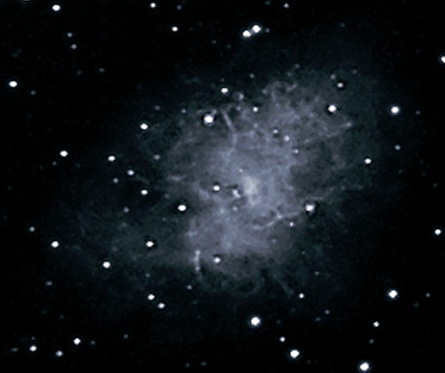
M1 The Crab Nebula


©2006 Richard Murray
Click image for larger view.


A pulsar lurks

"Imagine our enormous Sun compressed down to a mere 18 1/2 miles (30 kilometers) across and ramped up to a rotational speed equal to that of your desktop computers power supply fan (1800 rpm) and you've just described the Crab's central pulsar."

One of the reasons the Crab Nebula is such a notable object is that its sudden appearance took place only an eyeblink away at least on a 'cosmic' time scale. First discovered 950 years ago on July 4, 1054 AD by Chinese astronomers, this vast supernova explosion gained a brightness in the night sky at least four times that of Venus (-6 mag). It was visible for 23 days in daylight!

The nebula left over from the explosion is approximately 10 light years in diameter and is expanding at the rate of 1800 km/sec.

But what makes M1 so unusual is, in part, how it emits its light and the fact that it is really a nebula within a nebula. The outer nebula consists of the expanding gases and matter ejected by the supernova event. The inner nebula is the result of synchrotron radiation or polarized light created by a strong magnetic field filling the inner nebula. A magnetic field of this magnitude causes light waves to literally vibrate in the same uniform plane. The source of this radiation is none other than the source of the nebula itself. The star which went supernova in 1054 AD, has evolved into a rapidly rotating neutron star or pulsar and its gravity along with the magnetic field are pushing electrons to near light speed generating a very bright blue inner nebula core. And when I say bright, I mean bright because its overall luminosity in all spectral ranges has been estimated at 100,000 times that of our sun! It rotates or pulses at the rate of 30 times a second. Imagine our enormous Sun compressed down to a mere 18 1/2 miles (30 kilometers) across and ramped up to a rotational speed equal to that of your desktop computers power supply fan (1800 rpm) and you've just described the Crab's central pulsar.

The pulsar can just be seen, in the negative image above with the two arrows pointing to it.

Techno Stuff: LX90, ATK-2HS, 0.6 FR, Baader IR, 10fps, 98 X 30 secs, Brightness 55%, Gamma 0%,Sat 50%, Gain 100%, White Balance nothing selected, Darks used Processed in K3ccdTools, Registax, Photoshop, Selective color added.

Tuesday, December 07, 2004

NGC7635 The Bubble Nebula


©2006 Richard Murray

The Bubble Nebula is an unusual planetary nebula located
on the edge of the constellation Cassiopeia. The central
star, which is hard to miss, is the largest star in this image
weighing in at 40 times the mass of our sun. Its extremely
strong stellar wind results in an ever expanding shockwave
that is so fast and powerful that it literally slams into previous
stellar ejections to form the ever expanding 'bubble' wall that
we see. The bubble is expanding at the rate of 2000 kilometers
a second or 4 million miles per hour.

The nebula itself is about 6 light years across which means
that the distance from the sun to our nearest star, Alpha
Centauri, would easily fit within it.

This image was made by merging two images in Photoshop -
the color image taken with a Toucam SC1.5 webcam and a
black and white image taken with an ATK-2HS webcam. The
2HS webcam has a higher resolution which allows us to see
the actual 'bubble' of the nebula more clearly. The b&w image
was taken during a full moon so as time goes by I'll try to
improve this photo by imaging during a dark sky night and
then recombine the images.

Techno Stuff: Color image with Toucam SC1.5, 9/13/04 at 4:20am est (9:20am ut), LX-90 8" sct, baader ir, gain 70%, gamma 30%, saturation 50%, brightness 50%, white balance-outside, 125 frames x 45.5 secs,60 frames out of 125 processed in k3ccdtools, registax and photoshop, dark frames used

Black & White image with ATK-2HS 10/1/04 at 12:47am est (5:47am ut), LX-90 8" sct, baader ir, 0.6 focal reducer, gain 70%, gamma 0%, saturation 50%, brightness 50%, white balance-outside, 128 frames x 23.5 secs, 65 frames out of 128 processed in k3ccdtools, registax and photoshop, dark frames used

Saturday, November 13, 2004

M77 Galaxy

Reprocessed 1/4/05


This galaxy is located in the Cetus (The Whale) constellation and is approximately 60 million light years away. The photons that fell upon the ccd chip to make up this image were created around the time that dinosaurs roamed the earth!

This is a small spiral galaxy seen face on, one of the so called Seyfert galaxies, which in this case means it has a radio source probably caused by matter falling into a black hole. It is receding from us at about 1100 miles per second. Actually saying this is a small galaxy is a misnomer. It looks small but in fact it is very large. When you include the outlying gasious areas it's about 170,000 light years across. Almost twice as large as our Milky Way.

This image was taken from my front driveway on 11/13/04 at 1:00 am est with my new atk-2hs webcam. The small image below is with some false color added. The negative image beside it shows that M77 is larger than it first appears and in fact, its gasious envelope is almost as big as the galaxy itself.

Techno Stuff: 11/13/04 at 1:00am est (6:00am ut), LX-90 8" sct, baader ir, atk-2hs, gain 100% gamma 0% saturation 50% brightness 50% white
balance-outside, 22 frames out of 70 processed in k3ccdtools, registax
and photoshop, dark frames used


©2006 Richard Murray

Friday, November 12, 2004

M27 the Dumbell Nebula


©2006 Richard Murray

M27 has the distinction of being the first planetary nebula ever discovered, by Charles Messier on July 12, 1764. It's interesting to note that we are seeing this nebula face on rather than edge on. If we were to see it edge on it would probably look very similar to M57 the Ring Nebula (see my Archives: 8/8/04-8/14/04 on the left). This is a relatively young nebula being only 3000 to 4000 years old.

It also contains on its outskirts a variable star, referred to as the 'Goldilocks Variable' which was discovered by Leos Ondra. He found the variable quite by accident while looking at two different 1990 magazine covers that both featured a picture on their covers of M27. One picture had the variable star in it and the other did not even though the pictures were taken only a few months apart. Talk about serendipity! I've pointed out where the variable star is located with two arrows in the negative image above. So the fun part of all this is that in a matter of several months this star can actually disappear from view and then gradually brighten again. Now you see it, now you don't.

This has been one of the more difficult objects for me to image and I'm glad I was finally able to show this unique nebula.


Techno Stuff: 11/6/04 at 8:29pm est (1:29am ut), LX-90 8" sct, baader
ir filter, atk-2hs, gain 80% gamma 0% saturation 50% brightness 50% white
balance-outside, 14 frames used out of 25 taken, processed in k3ccdtools,
registax and photoshop, dark frames used. I increased the blue channel
with selective color in Photoshop. The negative was created in IrfanView
and contrast boosted in Photoshop.